…”Perfunctory Nazi dick biting.“
-Out of context quote
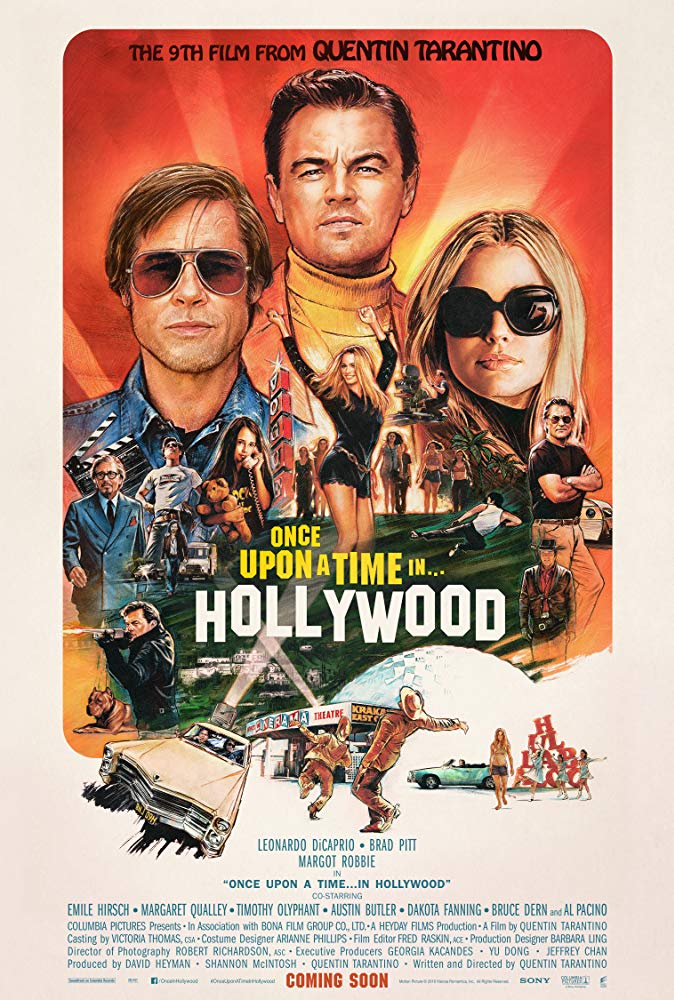
Once Upon A Time…In Hollywood is the 9th film from Quentin Tarantino. The trailer proudly proclaims this while Rick Dalton (Leonardo DiCaprio) enthusiastically flambes some Nazis with a flamethrower in a film within a film all while bellowing “Burn you Nazi bastards!” and cackling maniacally.
Quentin Tarantino is an artist who has a very distinct brand. CHances are if I hadn’t mentioned him in the opening paragraph you still would have guessed it was him. Outrageous, pop culture saturated, retro fascinated, ultra violent, cynical, witty and always riding the razor thin edge of good taste. “Sentimental” is a word you wouldn’t often associate with him. Nor “introspective” for that matter. “Subtle” can’t even get past the doorman to get in the room with him.
That is why this film is such a fascinating departure for him. You can almost see Tarantino looking inward and seeing two reflections of himself in the movie’s 2 leads. The unflappable badass cowboy with a dangerous side that he wants to be and the excitable, insecure artist finding himself a relic on the outskirts of a culture he fears is passing him by that he is in danger of becoming.
It’s been 6 days now since I saw OUATIH (catchy acronym) and I’m still unpacking how I feel about it. It think it’s largely because I’m struggling with how I feel about Tarantino himself these days. There were things to unabashedly love about this film that show that he is still a master of filmmaking. Oddly enough most of the elements I love about it are where he digs deeper than his usual bag of tricks, getting almost autobiographical in telling the story of Rick Dalton. However, it’s also a film that seesaws between that attempt at earnestness and a Tarantino-ness and that sometimes works to it’s detriment. It’s like he was afraid to fully set sail on a journey to something new and so he just ends up keeping one foot on the dock. The film juggles so many plot threads and tone shifts that a sense of viewer whiplash is almost inevitable.
THE SETUP
The central premise of the movie is comprised of 3 narrative strands that are gradually drawn together. In one we have the story of Rick Dalton, washed up film and tv star trying to resuscitate his career and his (only?) friend Cliff Booth (Brad Pitt), Dalton’s occasional stuntman but mostly driver/gofer. The 2nd thread follows Rick Dalton’s new neighbour, actress Sharon Tate (Margot Robbie) who has just moved into the house next to Rick with her husband: director of Rosemary’s Baby and statutory rapist Roman Polanski. The 3rd strand follows members of The Manson Family, a gaggle of brainwashed hippies under the spell of a washed up musician and criminal turned cult leader Charles Manson, going about their activities prior to the grisly crimes that would forever earn them infamy.
As a whole, the movie has 2 thirds that work pretty well and then one that’s more uneven. The central friendship between Rick and Cliff is genuinely a pleasure to watch. Two engaging actors have an easy going chemistry and a contrast in personalities that make them a fun pairing on screen. Their relationship is also intriguing because it’s an oddly symbiotic one as Rick relies heavily on Cliff to “carry the load” as he describes when we first meet them, not only physically by driving him around and doing house chores, but also emotionally by being there to pick Rick up when he’s down and buffing his ego when his confidence is lacking. Cliff for his part, seems happy with this arrangement. Rick’s fame and money allow Cliff to live comfortably (though not glamorously as we find out when we see his house in contrast to Rick’s), drive a nice car around and give him something to do since stunt work has dried up. While competent, ex war hero turned stuntman Cliff is generally unambitious, and maybe a little bit shady. He may or may not have killed his wife, hinted at in an abandoned plot thread that I don’t think was really necessary. It’s easy to see why he and fictional Manson Family member Pussycat (Margaret Qualley) initially hit it off when he offers her a ride. They’re both directionless drifters on the fringes of society, looking to their respective leaders to provide them direction and purpose. Cliff may not like hippies a whole lot (though it seems like it’s more a case of these particular hippies he doesn’t care for), but he has a lot more in common with them than he does the Hollywood types that forget his existence the minute he stops talking.
THE GOOD, THE BAD AND THE UGLY
Aside from the chemistry between the two lead actors, there’s a lot to like in this movie. Rick Dalton’s adventures on the set of Lancer provide a lot of the strong points in the film. This plot features great performances from Timothy Olyphant and Luke Perry (in his final on screen role), playing real life tv actors in a nice bit of historical symmetry. One of the standout scenes in particular depicts Rick having a self loathing induced meltdown in his trailer after he botches his lines, and manages to be both funny and heartbreaking all at once. Another involves Rick meeting child actress Trudi (who takes the whole enterprise much more seriously than he does) and Rick laying out the story of his life when talking about the book he’s reading about a bronco buster who feels “increasingly useless” after an injury. When Trudi asks how the book ends, Rick tells her he doesn’t know, he’s only half way through.
In the other plot threads, Cliff’s trip to Spahn Ranch and meeting with the Manson Family (absent Charlie) is basically a scene right out of a hillbilly horror film, with hippies swapped in for inbred cannibals. Tarantino slowly builds the dread and danger as Cliff realizes these particular hippies aren’t as innocent as they seem. It’s a moment that represents a turning point in the film as the first meeting of our protagonist and antagonist groups.
And finally, it’s worth mentioning the films and tv shows within the movie are all lovingly crafted homages to the classic Hollywood that Tarantino clearly has great affection for. Rick Dalton’s failed screen test for The Great Escape in particular, offers some laughs as DiCaprio is spliced into the existing film seamlessly in place of Steve McQueen.
That leads to the parts of the film that don’t work. With one notable exception (Robbie’s wonderful portrayal of Sharon Tate which I will get to more in the spoilers section) the depictions of real Hollywood figures tend to be perfunctory, unless they tie directly into the story that intersects with the fictional characters Dalton and Booth. Damian Lewis plays Steve McQueen in casting that is a stroke of genius and then is used only to give awkward exposition to spell out the relationship dynamic between Tate, Polanski and Tate’s ex BF/current BFF – Jay Sebring (Emile Hirsch). The other famous names Tate interacts with on her journey are just that – names. The film literally spells out who each person is on screen because it doesn’t have time to establish any of them as actual characters. Just names you’re supposed to recognize under faces that if you squint hard enough you might recognize.
It’s part of the general whiplash effect that this film has where in order to get to the final act (which I’ll get to in the spoilers section) it needs to drop as many clues as possible. So it contributes to the whiplash effect of the film going from this intensely personal story of an artist trying to find relevance in a culture passing them by to a historical drama complete with the heavy handed foreshadowing, name dropping and the cultural commentary (that the characters wouldn’t be aware of at the time) so prevalent in that genre. The film presumes a knowledge of the Manson Family among the audience and you can almost hear the DUN-DUN-DUN each time a name is dropped or a real life character appears.
Also, while I’m ripping into things that are just plain weird in a general way – Kurt Russell’s stunt coordinator character, also becomes the narrator half way through, for reasons that go unexplained. That makes this the 2nd Tarantino film in a row with terribly distracting use of narration, only this one has the added bonus of giving QT a chance to nerdsturbate a bit about spaghetti westerns. It feels like Kurt Russell only had a day to shoot his scenes, but Quentin wanted to give him a bigger part so he just slotted him in as narrator and never explained why he was telling the story.
So, I’ve reached the point where I can talk about things without spoiling anything major. With generalities out of the way. We now move to the spoilers section. I’ll give those of you who haven’t seen the movie yet time to do so (I’ll be here when you get back), or at least fair warning that from here on I won’t be holding back on spoilers.
Just gonna give people a bit of space to get out of scrolling range…
How was your weekend?
Do anything exciting?
Mine was fine.
Watched a movie.
Guess you already knew that, huh?
Ok. I think they’re gone now.
THE RUG PULL
So…Quentin Tarantino rewrote the ending to the Manson Family murders. I’ve been basically carrying that sentence around in my head for 6 days so I just needed to get it out. He does so in an incredibly violent but also comedic way (so basically the Tarantino way) and once that all kicked off I spent the rest of the movie stunned into silent shock. Instead of going to the Tate/Polanski residence, the trio (after Family member Linda Kasabian gets cold feet and bails on the whole thing) get intercepted and told to piss off by a drunk Rick Dalton and decide to change plans and go to his house instead. What follows is a shockingly violent confrontation involving the Manson followers, a stoned off his tits Cliff, Cliff’s well trained dog Brandy, Rick’s new Italian bride, and a flamethrower packing Rick Dalton. It’s chaotic, it’s gruesome and at moments, darkly humorous.
At this point in the movie I’ll freely admit I was having trouble focusing as I was still trying to make sense of what I was seeing. Like that feeling when you just narrowly avoid an accident that could have been really bad and just stare into space for a while waiting to get your wits back. I had taken the bait and swallowed every bit of foreshadowing that had me thinking “He’s not actually going to do this is he?” as the family members walked up the drive, only to end up thinking “I can’t believe he’s doing this.” when the film tips it’s hand. It reminded me of Kevin Smith’s proposed version of The Passion of the Christ where two ninjas (revealed as Jay and Silent Bob) swing in to fight off the Romans and cut Jesus down from the cross. Only Tarantino actually did that.
When this movie was first announced, I was one of many voicing serious reservations about a director famously known for his love of gratuitous violence to be handling a real life tragedy. As I said at the start, he is not subtle and the potential for exploitation was so permanently parked in my brain that I had spent the first two thirds of the movie thinking “he’s not going to do this, he’ll cut out before” or “maybe it’ll happen off screen?”. All of those doubts, all of that dread I was feeling came rushing out in a moment of utter bewilderment. Tarantino had basically loaded us up in the car, pointed us toward a cliff and only hit the brakes at the absolute last possible second.
THE HOLLYWOOD ENDING…
If nothing else is accomplished by this movie, it will have given back Sharon Tate some of the humanity she lost when she became symbolic of a crime and cultural moment that instantly erased her past achievements. She took up a place in history alongside Altamont and eventually Watergate as a symbols of the end of the innocence and optimism of the 60’s and the birth of a colder, more cynical world and in the process stopped being a person. While unimportant in a plot sense, scenes of Tate going about her day, giving a lift to a friendly hitchhiker, buying a book for her husband and then going to a movie are absolutely crucial to giving her life and humanity that the Manson Family took away.
Quentin Tarantino has been known for revitalizing the careers of actors who have faded from the public consciousness. In this film, he gives that treatment to two actors who are no longer with us. One being Luke Perry who passed away suddenly prior to the film coming out and the other being Sharon Tate, whose career has been buried under historical baggage for half a century. For those my age, who had only heard of Sharon Tate as a historical figure in relation to the Manson Family murders, seeing her depicted as more than just a name in a news article really hit home for me.
One of the most emotionally effective scenes happens when the real Sharon Tate is allowed to take center stage during movie Sharon’s trip to the cinema to see The Wrecking Crew. It’s a scene that gives Sharon life as an artist of her own renown who took pride in her work and the happiness it brought people. It reminds us that she had an identity beyond “Manson Family victim” or “Roman Polanski’s pregnant wife” which are the two most often used identifiers that accompany any description of her. This could have been a moment where Margot Robbie was inserted into the film (as we saw with the Great Escape clip, the technology was available), but Tarantino included the real deal and it was absolutely the right choice.
For all of it’s faults, this film manages to give a happy ending to someone that life gave a very rotten ending to. The answer was right there in the title the whole time. The movie is a Hollywood fairytale, complete with a happy ending. The final scene remains the one and only time a Tarantino film has made me tear up. Hearing Sharon’s voice on the intercom asking Rick about what had happened after the break in was that fairytale coming to fruition. Yes it’s wish fulfillment in the same way that Hitler being gunned down in a burning theater was wish fulfillment. Sometimes when the world sucks so bad, art is the only avenue we have to write a happy ending.
As a final note on Sharon Tate’s depiction, I also appreciated the fact that the two men who would come to define her legacy (Roman Polanski and Charles Manson) are largely absent from this film. Based on the trailers, one could call it a bait and switch given Manson’s prominence there, but I didn’t mind. Charles Manson has had more than enough screen time. And I appreciated that this piece of art gave her top billing in her own story.
FAMILY OF FUCK-UPS
This movie does another very welcome service and works to demystify the Manson Family by openly mocking them and everything they stood for. They aren’t supernatural boogeymen. They aren’t criminal masterminds. They’re depicted as brainwashed, mentally unwell, bumbling idiots under the sway of a dangerous con man (why does that seem oddly familiar today?). They were white supremacist assholes who deserve the loser edit of history this movie gives them. When Cliff asks Tex Watson’s name, his infamous line “I am the Devil and I’m here to do the Devil’s work” gets immediately clowned as Cliff bats it away with “No, it was something dumber…like Rex.”
No horror monster gravitas here. No dignity. Just straight mockery.
Then Cliff’s dog Brandy bites Tex in the junk. I give this scene an A+. Good dogs biting white supremacists in the dicks is always an A+. Sometimes there is something to be said for Tarantino’s lack of subtlety.
THE BRUCE LEE THING…
While we’re talking about real life depictions of Hollywood characters, one figure who is not depicted in as lovingly a way as Sharon Tate is martial arts legend Bruce Lee.
Lee is shown in a flashback to the set of The Green Hornet where he gets into a fight with Cliff Booth. Bruce is depicted as arrogant, preachy, short tempered and he immediately butts heads with Booth (and maybe head-butts…I’m going off of memory here) who isn’t buying what he’s selling.
I didn’t have as much of an issue with this scene as some have, because the scene is depicted as a flashback through the recollections of Cliff Booth who is – at best – an unreliable narrator. So you can make the case that he’s bigging himself up as the hero of his own story and even then can only manage a draw in his imagination.
The thing with legendary figures is we have a tendency to elevate them beyond human to infallible status and that ends up stripping away their humanity. The 1993 biopic Dragon: The Bruce Lee Story had a similar issue of minimizing or removing Lee’s flaws in favour of an idealized version. That Bruce Lee wasn’t a person, he was an action figure that you pull the string on to say catchphrases. The same personality flaws that Cliff Booth laughs at, could easily be seen as positive traits that were key to understanding Bruce Lee’s charisma and mystique which have endured for 50 years. We’re so used to depictions of him always being through a fawning sterilized perspective, that anything that shows a different perspective becomes heresy.
Through a different lens, “arrogance” becomes “confidence” or “swagger”, “preachy” or “condescending” becomes “wise”, “hot tempered” becomes “driven to test himself”. All key aspects of why Bruce Lee still resonates are in the film, just shown from a different perspective.
THE QUENTIN PRINCIPLE
As I try to condense down my final thoughts, I have to address the elephant in the room. Revelations about Tarantino’s on set behavior and just overall changes in my perception of him over the last few years couldn’t have been any more on my mind during my viewing of this movie if they were sitting in the seat next to me stealing my M&M’s the whole time. I’ve read the story of him endangering Uma Thurman’s life on the set of Kill Bill in a stunt she wasn’t comfortable with and causing her lifelong injuries. I’ve heard the stories him insisting Diane Kruger be choked for real (and him being the one to do it) while shooting Inglorious Basterds. I’ve seen the cringey video of him trying to “talk black” while promoting Django Unchained on BET. I’ve heard him defend his use of racial slurs in his movies citing “realism” and “honesty”. All indications are that he’s one of those people that thinks he’s so woke that he’s got special permission to use the word and just…no.
What I’m getting at is it’s hard to leave that stuff at the door when those personality flaws are the dark half of what makes Quentin Tarantino. Much like Bruce Lee can be seen in different ways depending on whose eyes are looking at him. His work is so intrinsically tied to the madness, perfectionism and the single minded pursuit of art above all else, that it’s impossible not to think about that stuff (for me, your mileage may vary). His films are so intensely him that all I have to do is say Tarantino-esque and immediately a set of sensibilities, tropes, recurring themes and elements will immediately come to mind.
Thinking about this movie and trying to reconcile the half of it that really worked and the half of it that left me with mixed feelings makes me feel like he was trying to do something different here but he was unsure if audiences would like something of his that didn’t have the violence, cynicism and mayhem that is his brand and so he felt he had to include that stuff even if it felt perfunctory to do so.
Yes, I’m including even the Nazi dick biting in that. Perfunctory nazi dick biting.
Once Upon A Time In…Hollywood is at it’s most insightful when it’s about the aging artist trying to find his place in a culture that has seemingly no more use for him.
It’s in the oddly self referential moments like Al Pacino’s agent Marvin Schwarz (who manages to be the most Pacino-y Pacino that ever Pacino-d) fawning over Rick telling him how much he loves the killing in Rick’s action movies and Rick just shuffles uncomfortably nods along.
It’s in scenes with Rick on the set of Lancer. A has been used to playing the fall guy for whatever new cowboy actor the studio was trying to big up (a strategy spelled out by Schwarz earlier), being given a chance to grow and step outside his comfort zone by an eccentric director who sees more potential in him than he sees in himself (echoing QT’s own history of reaching out to “has been” actors to offer them career changing roles). Rick dons the hippie fringe jacket he initially protests, allows his face (the moneymaker for a star) to be hidden behind false facial hair and finds some redemption by digging deep and discovering new skills he didn’t know he had. He pushes himself to keep with the times rather than falling back on the old patterns that don’t work anymore. I feel like there are so many parallels to what Tarantino was trying to do in OUATIH (again..just an acronym that rolls off the tongue) but hedged his bet just in case which is what made this movie a frustrating watch.
And of course this section of the film gave us “evil sexy Hamlet”. A legendary moment if ever there were one.
It seems like it’s no coincidence that the two characters who Tarantino sees most lovingly in this movie are the artists (Sharon Tate and Rick Dalton). He manages to find within them kindred spirits who take personal satisfaction in a job well done. For Rick, it’s a precocious young child actress telling him his performance was the best she’d ever seen and for Sharon it’s quietly watching her movie with an audience that doesn’t know she’s there and being giddy at the response to it. That’s the good stuff. That’s what resonates in this film. Not an ass kicking cowboy like Cliff Booth, who is always depicted with an air of self insert fantasy and “too cool for school” flawlessness. He doesn’t feel as real as a guy trying to remember his lines while he’s hungover.
I used to bristle at the idea that Tarantino had once floated about directing a Star Trek film. After seeing OUATIH (an acronym sounds like the involuntary noise you make when you throw up), I’d kind of like to see what he would do with something like that. Something optimistic and divorced from the nihilistic violent circus that seems to have become the corner he’s painted himself into. Tarantino had his angry young man phase, and I think we’ve finally seen a little peak into a new phase for him. Something like Trek is basically as far removed as you could get from a Tarantino film. If there’s a lesson in OUATIH (Bless you!) it’s that he does have some hidden depths that might be worth exploring. I think when you take away the bluster and the cynicism and the cartoonish violence that for 30 years has been his persona, there’s a deeply sentimental person underneath all of that.
P.S.: Fuck Roman Polanski. I made a swipe about him being a statutory rapist earlier and I wasn’t just being flippant. Tarantino (who at one time defended Polanski, but has since apologized for it and denounced his past comments) includes a scene where Pussycat explicitly makes a pass at Cliff Booth and he shuts her down. If nothing else, I can give credit that QT has shown enough growth to recognize that the responsibility is on the adult in the situation to behave like an adult. Including that message in the movie (from the cool character no less) is a positive thing and shows a level of social responsibility I didn’t think he had. I know it’s a low bar to clear, but I find it important to recognize growth.
Author’s Note: Thanks to my friend Niall Howell, who helped me talk through a lot of this stuff and organize my thoughts over a long overdue lunch. Niall has written a book called Only Pretty Damned it’s pretty great so you should read it.

 RogueType.com