
In 1993, we all learned what a Velociraptor was, and to be terrified of them. It took roughly another decade to learn that they were actually about the proportions of a mid sized dog and the Deinonychus was closer to the depiction of the film’s terrifying dino-tagonists, but it wasn’t as cool to say. Most 90’s kids can track our maturation process based on later learning what parts of Jurassic Park were the science and what parts were the fiction.
This film left a lifelong impression on me, to the point where even three decades later, after two diminishing returns sequels and a reboot trilogy that is obsessed with trying to turn Chris Pratt into Han Solo (and failing every time), the original dino disaster movie still manages to hold up as a generation defining classic.
When I sat down to start filling out a list of pop culture subjects that are meaningful to my life – to come up with a roadmap for things to write about – Jurassic Park was the immediate first entry on the list. It was one of the earliest videotapes I owned, and it holds a special place in my life, which I’ll get to in good time.
That also presented a challenge, because what is there to say about a film like this that hasn’t already been said? As I gathered my thoughts to talk about it, I found myself not thinking of the absolute perfection that is the T-Rex jeep attack, the exhilarating rush of the tree climbing scene or the tension of the Raptors in the kitchen.
I could spend a whole lotta words unpacking the line “Hold onto your butts”, which manages to be less crude than Samuel L. Jackson’s usual verbiage, but more provocative all the same . It shoots the moon from brilliant to silly to evocative to absurd and back to brilliant again. The vivid picture it painted of Grant and Sattler grabbing their own cakes as a defensive posture is something adult me judges kid me harshly for finding as amusing as I did.
That stuff is all great, but recently I’ve found myself thinking about the more murky human themes of the film. One character in particular has taken up a lot of my headspace and that is Jurassic Park creator John Hammond. He has become more relevant the older I get and the more I see echoes of him in tech gurus and “disruptors”. I’m interested in the change of John Hammond from Michael Crichton’s original 1990 novel of the same name, to the film counterpart who is different in all but name and economic status.
Before I get there, though let’s talk about the movie itself.
“What Do They Have In There?…King Kong?”
Steven Spielberg often described watching King Kong as a childhood moment that captured his imagination and showed him the magic of film. Jurassic Park had a similar effect on 8 year old me when I saw it for the first time.
There is the moment where we see the wires bending and snapping as the rain pelts down on 2 stranded Jeeps. The groaning of steel beneath the power of something immense but just out of sight. The shot tilting up to reveal the enormous head of the T-Rex wolfing down the bait goat before letting out the iconic roar and lumbering out into the road still gives me chills to describe it some 30 years later.
I think often genres such as monster movies (and horror movies more broadly) tend to get unfairly dismissed as low grade forms of filmmaking. Often written off as cheap thrills without substance.
Monster movies are inherently resonant and emotional films because they often provide a mirror into ourselves in ways other genres don’t. They poke us in our primitive reptilian lower brains, playing on our base fears and anxieties. More than any other genre of entertainment, if you want to know where a culture’s anxieties are you need to look at the monsters we project those fears on.
Films like Jurassic Park harken back to humankind’s early fears: that of predation by hostile wildlife. The fear of tooth, fang and claw is as much a part of our species history as breathing. It is primal within us. That makes monster movies an easy source of thrills because they tap into something primal and autonomic within us.
For all of the special effects mastery and taut filmmaking on display in Jurassic Park and for all of the earnest intentions of treating the dinosaur inhabitants as animals and not malicious monsters, Steven Spielberg had been very upfront with Jurassic Park being a monster movie.
There is something about this kind of spectacle genre film that grabs you as a kid and inspires wonder. Part of the reason is that when we are young, everything is bigger than us. We all grow up vulnerable, surrounded by creatures many times our size. As we grow older, we realize that the actual monsters in life are often much more complicated and nebulous than big roaring animals. Concepts like bigotry, cruelty, greed, selfishness and ignorance wear human faces and can’t be outrun in a Jeep or defeated with a one liner and a punch in the face.
That’s where the generational transition comes in that helps to explain Jurassic Park’s longevity. T-Rexes stop being as scary after you’ve seen them a few times. (Particularly true after seeing behind the scenes footage of Stan Winston’s massive animatronic T-Rex shivering in the rain…poor fella.) It’s from that point that monster movies go one of two ways. If they are purely built on watching monsters of the snarling, beastly variety chasing people, they’ll likely remain in that cheap thrill designation. A bit of fun to kill an afternoon with and that’s not a bad thing. However, if there is another layer, a layer of humanity built in to the monstrous, then the films can grow up with you.
This transition is part of the reason Jurassic Park has a multi generational appeal. As one grows into an adult, our understanding of the world gets more complex and so do the things we are scared of.
Corporate greed, negligence, incompetence and hubris are far more likely to kill us than cloned dinosaurs. Part of growing up is realizing that.
Page to Screen
I read Jurassic Park when I was in junior high. It was several years after the movie had come out,
One of the things I found while reading the novel was that when it comes to characters and plot, Spielberg remixed the work of Crichton liberally. The film changes almost every character, both in presentation as well as personality. Except for Dennis Nedry, who is basically the same but doesn’t squeal like a balloon letting out air in the books.
That was pure Wayne Knight genius.
On a side note, can I just say that I’m having a hard time deciding if giving your sloppy, IT guy antagonist a last name that’s a lazy anagram for “nerdy” is either genius or compete hackery?
I don’t find the idea of changing source material when transferring from one medium to another to be a bad thing. In film, logistically there are a lot of restrictions you don’t have on the page. When your characters are just words on paper, you don’t have to consider the logistics of paying and working with actors. You can populate a story with hundreds of characters, as many locations as you can dream up and dense worldbuilding, because that stuff all carries the same price tag to implement on the page. It’s one of the beautiful advantages books have as a medium. An epic battle and a conversation require the same resources, which are ink, paper and imagination.
Structurally, you also don’t have to worry as much about pacing issues as novels aren’t designed to be finished in one sitting anyway. A regular sized novel, you go in with the expectation that you will start and stop along the way.
On the flip side, the language of film and the compact time allowance of a few hours often means that character arcs need to be more identifiable, because films are designed to be experienced in a single sitting. A lack of a satisfying narrative arc is much more noticeable.
To pull the brain train back onto the Jurassic track, let’s use the example of Alan Grant for illustrative purposes. Book Alan Grant is a large jovial bearded man (loosely based on paleontologist Jack Horner) and he is great with kids. Spielberg changed his characterization to provide more of a simple and clear arc for him from beginning to end, where Sam Neil plays him as a grump who hates kids and over the course of the film, gradually lets him warm up in his role of protector.
He also has no beard in the film. The thematic resonance behind that change is Sam Neil didn’t grow a beard. Not all of the observations are going to be winners, folks.
These kinds of changes happen all over the transition from book to film when it comes to Jurassic Park. Character and plot points are remixed freely, characters omitted from the film have their traits and moments absorbed into remaining characters, there are people who live in the film but die in the books, and there’s a scene completely omitted from the film where the Alan Grant defeats a pair of raptors in a dance off.
Probably cut for time. It’s totally in there.
The reason I’ve devoted time to talk about this is because I have to make an acknowledgement that sometimes things are changed purely for dramatic purposes. I’m going to be doing a bit of thought experimentation and speculating here in regard to the motivations behind the change and perhaps it is possible that I’m way off base in my read on the situation. Just wanted to put that out there.
I could be wrong on basically everything.
In fact there’s a pretty good chance of that.
Anyway, let’s talk about John Hammond…finally.
John Hammond…finally
The change that interests me the most when it comes to Jurassic Park’s trip from the page to the screen is to the characterization of park founder John Hammond. I think there’s quite a bit to dig into there.
In the book, John Hammond is much more of a straight up villain. He is largely motivated by greed, is petty and vindictive (some of which did carry over in Hammond’s interactions with Nedry). Book Hammond has little regard for the safety of his own grandchildren Tim and Lex and deflects any personal responsibility for the park’s failures. He constantly blames others for his mistakes. While walking around, contemplating how everyone else’s personal shortcomings are the cause of the disaster, he falls down a ravine like a clumsy asshole and is eaten by a pack Compies.
Now I won’t say that book Hammond doesn’t have some real world counterparts and that there aren’t actual billionaire “visionaries” like that in the world who cause havoc and refuse responsibility for their actions with impunity.
Relevant link: Actually, It’s Called Zuckerberg’s Monster
What I find interesting is that Steven Spielberg has himself pointed to a shift in his own priorities that has been reflected in his early 90’s work. Richard Dreyfuss’ character in Close Encounters of the Third Kind abandons his family to go on a spaceship, a creative decision Spielberg later admitted he wouldn’t have made as he got older and had a family of his own. Hook (1991) seemed to be a bit of Spielberg working through that conflict of balancing adult responsibilities with the fun and spirit of youth through the character of Peter Pan.
In a similar way, I think there is an element to Jurassic Park that is Spielberg working through the conflict between the starry eyed dreamer and grown up with responsibility as he settled into middle age.
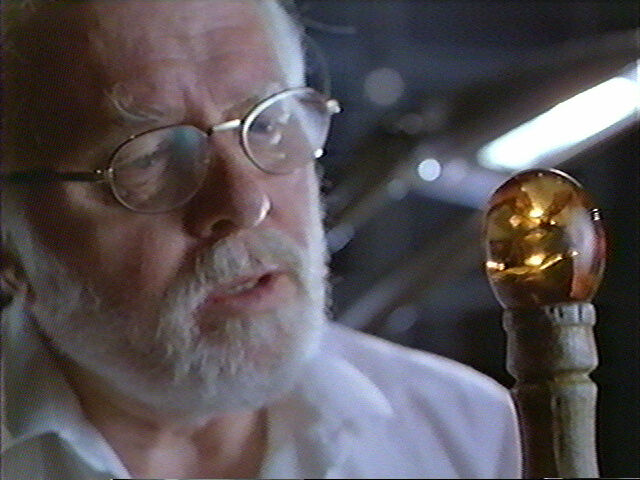
John Hammond in the film is a warm, grandfatherly type. He’s not a monster in a personal sense, but he is responsible for a significant amount of death and destruction. Sir Richard Attenborough plays him as charming and gregarious, with a zealot’s passion for creation and wonder. He is a true believer in the awe he wants his attractions to create.
Hammond has a wonderful scene with Laura Dern’s Ellie Sattler where he sadly contemplates the failure of his dinosaur theme park while eating expensive melting ice cream in the dark (and who among us hasn’t had that moment before?). He reminisces about his first attraction, which was a mechanized flea circus. It was an illusion where the audience’s imagination fills in the gaps of what they can’t see. His desire to create Jurassic Park came out of an urge to make something real. Ellie snaps him out of his self-pitying state by pointing out that the reality he wanted to create came with a very real danger that was not properly accounted for.
I think what interests me most about the change in Hammond’s characterization and motivation is how it reflects back on some very real stuff Steven Spielberg was going through professionally at the time.
Watching Jurassic Park again for the umpteenth time, I saw glimpses of a different John at the helm of Jurassic Park. That being John Landis.
The Trial of John Landis
In 1983, Spielberg was set to co-produce and direct a movie adaptation of the Rod Serling classic series The Twilight Zone. Spielberg’s co-producer and director was Blues Brothers director, John Landis. The idea was for the movie to be an anthology where 4 directors (Spielberg, Landis, Joe Dante and George Miller) would each contribute a segment to the film.
Landis’ section told the story of a racist named Bill Conner (played by character actor Vic Morrow) who is transported back in time and is forced to see racism from the side of the marginalized. He first lands in Nazi Germany and is apprehended for not having documentation and not speaking German, then he ends up in the Jim Crow south where he is accosted by Klansmen who attempt to lynch him (thinking he is Black due to a muddy face), then he falls into a pond and emerges in a Vietnamese village where he is fired upon by American soldiers.
[Note: Before I carry on, I do want to give a content warning here that I will be talking about a real life accident that resulted in the deaths of 3 people, two of which were young children. I won’t be going into any of the specific details as this isn’t a true crime blog but just a heads up for the next few paragraphs.]
At this point in the film, in a redemptive moment Bill was supposed to grab two young Vietnamese children and to carry them across the pond to safety. I say “supposed to” because the scene was deleted from the film.
As Morrow gathered up 7 year old Myca Dinh Le and 6 year old Renee Shin-Yi Chen and began slogging through the water, a helicopter circled overhead. A nearby pyrotechnic charge caused the helicopter to go into a tailspin. The chopper plunged into the water, killing Vic, Myca and Renee instantly and injuring the 6 people aboard the chopper.
It was found during the investigation that the two children involved in the scene were not supposed to be working at 2 am or in close proximity to explosives. Landis had skirted California labour laws in order to hire the two young actors by paying them under the table. The parents testified that they had been pressured by Associate producer George Folsey Jr. not to tell the firefighters that the stunt involved children.
The tragedy resulted in nearly a decade of lawsuits and criminal trials as well as ripple effects felt throughout the entertainment industry to this day. John Landis as well as Associate producer George Folsey Jr., pilot Wingo Dorcey and production manager Dan Allingham were tried and eventually acquitted for manslaughter in 1987.
The decision not to prosecute John Landis for his violations of labour laws was very controversial at the time.
Steven Spielberg, was never party to any criminal charges. From all available evidence, he was not on set and was unaware of the stunt as it was a last minute change by Landis. Spielberg was party to a civil lawsuit, which was settled out of court, however it seems that was more a technical matter as he was co-executive producer on the film.
[Note: As I was writing this piece I googled to see if any other writing had been done on this connection and found that of course it has, because there are no new ideas. JM McNabb had written a piece for Cracked earlier this year that also covers this Landis-Hammond connection. The piece goes into much more detail on the accident and the subsequent legal issues and if you’re interested in learning more of the specifics about The Twilight Zone movie accident, I encourage you to check it out.]
Link: https://www.cracked.com/article_30251_the-dark-allegory-hiding-inside-of-jurassic-park.html
The ripples of the Twilight Zone Movie were severe on a personal as well as professional level. Steven Spielberg was so disgusted by John Landis’ conduct in the whole affair, that it ended their decades long friendship. Spielberg subsequently cited the Twilight Zone Movie accident as a wake up call that the “New Hollywood” generation needed to grow up.
This may require some unpacking.
New Hollywood, New Problems
The 1970’s was the decade of the “auteur director”. It was the age of the film director as rockstar visionary with broad control over their films during all phases of production. You couldn’t be a true “auteur” if you didn’t write and direct your own films.
Before this new wave of auteurs, directors in filmmaking were largely treated as almost an administrative position. Just someone to keeps things moving along on set. Directors were considered largely work for hire types in a much more collaborative environment, with key creative decisions spread out among the various producers, writers, editors and cinematographers. The New Hollywood era made auteur theory the new hot thing (“auteur theory” was largely a French film trend that had been imported). Directors not only directed, but also had a hand in writing the scripts, cinematography, casting, producing and editing.
There’s really no other way to describe it other than: auteur theory was dictatorship of the artist. To distill it into a single idea, it was filtering a collaborative process through the singular vision of one person which also meant that the credit also was filtered similarly. Directors became rock star famous in this generation and often as much of a selling point as their films.
Auteur theory was the hot and popular trend of the new wave of the Boomer Hollywood generation but also had a dark side. Like every bubble that eventually has to burst, the risks got bigger, the money got out of control and an industry run by a generation of mostly young white men “feeling their oats” led to a permissive environment where responsibility was secondary to artistic vision.
As we gain more distance from that era, the problems with the dictatorship method become more clear. When you have directors who are used to having control over every aspect of film production, in service of achieving exclusively their vision, and they are lauded with cult like reverence for it and given money hand over fist, it becomes easier to see where that might encourage some unhealthy behavior. An environment of record breaking film profits, a permissive environment and a lack of checks on director power in this era led to several stories of abuse of that power that we are still untangling half a century later.
For example, Ellen Burstyn told the story of permanently injuring her back while doing a harness stunt in The Exorcist (1973). During a scene where Burstyn is hurled the floor, a stunt harness was used. Burstyn asked Director William Friedkin to tell the harness operator to lighten up because it was hurting her back. Friedkin’s response was “it has to look real”. The director eventually acquiesced, however Burstyn cast doubt on whether that message got passed along because subsequent attempts as the stunt were just as grueling.
We’ve also learned since the receding of the auteur era, that not all abuses of power result in physical injury or death. Stanley Kubrick psychologically tortured Shelley Duvall while filming The Shining. He isolated her on set, verbally berated her constantly and infamously forced her to do the baseball bat scene 127 times, intentionally trying to create an exhaustion induced breakdown in his actress.
A more modern example such as Quentin Tarantino (considered one of the last true auteurs still operating) nearly killing Uma Thurman in a car stunt while shooting Kill Bill and personally strangling Dianne Krueger on the set of Inglorious Basterds (2009) to the point of her passing out for real.
These examples have painted the legacy of auteur theory in a much darker light. Not only does it reduce the collaborative artistic effort of filmmaking into a cultish dictatorship, it also enables overgrown man children to abuse others with impunity in the name of “artistic vision”.
We have grown to recognize the toxic patriarchal undertones of so much of this permissive behavior. For the same reason that only white men are allowed to “go Method” in their acting and get away with treating their colleagues like garbage, a “boys wills be boys” system was enabled because of the supposedly irreplaceable “genius” of powerful men.
[Note: In an often repeated tale, method actor Dustin Hoffman (who was himself accused of sexual harassment during MeToo so…on brand for this piece) stayed up for days to play the exhaustion required for a scene in Marathon Man (1976), which bothered co-star Laurence Olivier who supposedly responded “Try acting, my dear boy.”]
We now recognize that the radical “New Hollywood” were often little more than privileged men being allowed to get away with behaving badly without consequences. This change in modern perspective helps put into sharper focus what Steven Spielberg meant when he said Hollywood needed to grow up.
John Landis was not an anomaly. He was a product of the environment he was in. It was an environment where risk and consequences didn’t factor in.
When Jurassic Park came out, I had no knowledge of The Twilight Zone movie. I wasn’t born yet when the incident happened. Having learned more of the context around the environment of the film’s production, I can’t unsee the similarities.
The conflict of John Hammond illustrated within Jurassic Park of safety vs realism is a constant balancing act in art.
Recounting the stories of Landis, Friedkin, Kubrick and Tarantino, it becomes a question of how much are we willing to tolerate in the appeasement of creative genius? At what point does somebody step in to say “No, the audience can imagine the fleas”.
We’ve grown less tolerant of artists using the pursuit of realism as an excuse to cut corners and put people in real danger.
I find myself grappling with my own complacency as a filmgoer when it comes to this conflict. I’ve been guilty of romanticizing dangerous stunts over digital alternatives. I’ve applauded Tom Cruise’s borderline suicidal and increasingly dangerous Mission: Impossible stunts in the past. In those cases, the actor is the one pushing for the stunt, not having it pushed on him.
I’ve begun to re-evaluate how I view that balance. Avengers: Endgame stands out to me as a positive counter example. Digital effects were used in the film to emaciate Robert Downey Jr. in a way that would not have been possible (or safe) in a pre-digital world. While watching the film, I thought about how often we as filmgoers had glorified actors putting on and dropping extreme amounts of weight for movie roles. It’s often incentivized when Oscar season rolls around, even though it is incredibly unhealthy.
“Must go faster. Must go faster.”
The phrase “fuck around and find out” has become incredibly useful modern colloquialism in describing the ebb and flow of reckless actions and consequences. What I like about it is the “fuck around” part acknowledges the almost childish, unsupervised, “getting away with it” connotations that underpin recklessness. The “find out” section kicks in when a person (or industry, or company) is suddenly confronted with consequences they either ignored or were too insulated to recognize as a possibility.
John Landis found out, much like his spiritual counterpart John Hammond. Crucially, it’s important to recognize that neither of these men exist as anomalies in their worlds. They were products of systems, ideologies, trends, privileges and environments that enabled their recklessness until the consequences became too severe to ignore.
One of my favourite jokey ways to describe the central theme of Jurassic Park is that the lesson here is “pay your IT people well”. While that’s admittedly a reductionist and flippant way of describing the inciting incident of the failures of the park, it does get to the heart of the hubris of John Hammond and the reckless pursuit of his vision.
Annoying little things like adequate staffing, compensating the work of employees, operational safeguards, safety redundancy and laws become just obstacles to be dealt with as efficiently and quickly as possible when you are a John Hammond.
The same way John Landis felt those pesky child labour laws pyrotechnic regulations were just annoying obstacles getting in the way of his getting what he wanted.
The same way the producers on the set of the film Rust decided that bringing in non-union crew after the film crew walked off set due to a lack of safety protocols was a good idea. Until it became a bad idea. Until a live weapon misfire ended up taking the life of cinematographer Halyna Hutchins and injuring director Joel Souza.
Jurassic Park was Spielberg calling out his own community. I have to respect that he didn’t go for the soft target. It would have been easy to stick to the book and paint Hammond as a cold, sociopathic capitalist. A mustache twirling villain devoid of humanity. Instead, Spielberg put himself and his colleagues under the microscope by framing the ultimate failure of Jurassic Park as a result of a combination of ambition and tunnel vision in service of artistic realism.
The elements of greed are still present in the film, in the character of lawyer Donald Gennaro, who was much more heroic and an everyman in the book. Film Gennaro was the recipient of most of book Hammond’s less admirable traits in the whole creative game of musical chairs that was JP’s trip from page to screen.
What I think is worth noting about the film is that the cowardly avatar of greed and exploitation (that was John Hammond in the novel) gets eaten by a T-Rex on the toilet in the film. It’s the kind of humiliating, ignominious fate that Hammond got in the books.
One could look at the change as Spielberg absolving John Landis, but I think there’s something else to it.
John Hammond in the film gets no quick or immediate closure. He has to live with the damage he has caused. He is forced to face accountability in a way that isn’t as satisfying as a demise at the hands of a dinosaur. He dies an old man, reputation tarnished, buried in lawsuits and forced to try to make right what can never be fixed until his dying day.
We live in a reality where powerful people are very rarely held accountable for the damage they cause, often insulated by their wealth and privilege. It’s often why we turn to escapist entertainment to provide that catharsis. While the catharsis can take the form of a crowd pleasing grisly fate, Spielberg models something a bit more complicated. He models atonement and growth.
By showing John Hammond renounce his creation and realize the gravity of his mistake, Spielberg evokes a figure more akin to Alfred Nobel, who invented dynamite and later went on to found The Nobel Prize as a measure of remorse for the destructive implement he gave to the world. Hammond mirrors J. Robert Oppenheimer, known as the Father of the Atomic Bomb who realized the destructive potential of his creation and became a staunch opponent of nuclear proliferation.
The answer to the questions at the center of Jurassic Park lie somewhere in the spongey middle between Hammond’s reckless pursuit of advancement and Ian Malcolm’s staunch opposition. Neither perspective is entirely right, but neither is entirely wrong either.
We need scientific progress. Anti-science fearmongering fails even the most basic logical test when pointing out that the roof over my head, the radiators keeping me warm in the night, the electricity that allows me to write this and the circuitry in my laptop were all new and distrusted technology at one point.
Ever since our ancient ancestors started creating tools, humanity has dealt with the core question at the heart of Jurassic Park. Every technology has a benefit as well as a potential to be misused. The first human to fashion tool out of rocks and sticks, was also fashioning a weapon. The difference was human nature, and that’s not a problem easily solved.
Final Thoughts
I’ve been sitting on this piece for a few months now. Mostly in trying to figure out a way to end it. I began writing it before the tragic death of Halyna Hutchins (which seems like it happened years ago, but that’s pandemic time for you). In the same way that the January 6th US Capitol insurrection basically caused me to throw my Hamilton 3rd part in the bin, real life has a way of changing how we look at things. Particularly when you take a while to write.
As much as the systemic problems that John Landis/John Hammond illustrated may seem to be far in the past and a relic of a bygone era, the past 6 years have illustrated how short memories can be and how a few generations removed can un-learn very painful lessons. Systems are only as effective as the humans who maintain them and the safeguards that underpin them.
The circumstances and responsibility for the Rust tragedy will likely be years from understanding completely. Much like The Twilight Zone Movie, we’ll likely be unraveling these systemic failures many times over the coming decade as all of the various threads of culpability are untangled in the legal cases currently ongoing. That fact that this incident occurred during a labour dispute and a potential strike by IATSE (International Alliance of Theatrical Stage Employees) who were asking for things like fair pay and less exhausting working hours drives home the fact that single incidents often have causes and systemic contributing factors far beyond the initial scope.
The human and systemic failures which took the lives of Vic, Mica and Renee and Halyna are all cut from the same cloth as the failures of Jurassic Park explored within the character of John Hammond. When tunnel vision and privileged ambition meet hyper-capitalistic profits-before-people mindsets, that’s when corners get cut, unnecessary risks get taken and lives get irrevocably damaged.
While Jurassic Park never set out to solve these problems (it is after all…a monster movie), I do have to give credit that Spielberg did not shy away from chosing to call out the toxic destructive side of the pursuit of creative vision.
————————————————–
Thank you for reading. Hopefully you enjoyed or got something out of this hodge podge of thought soup. You can follow me on Twitter @TheRogueTypist if you are so inclined.

 RogueType.com